
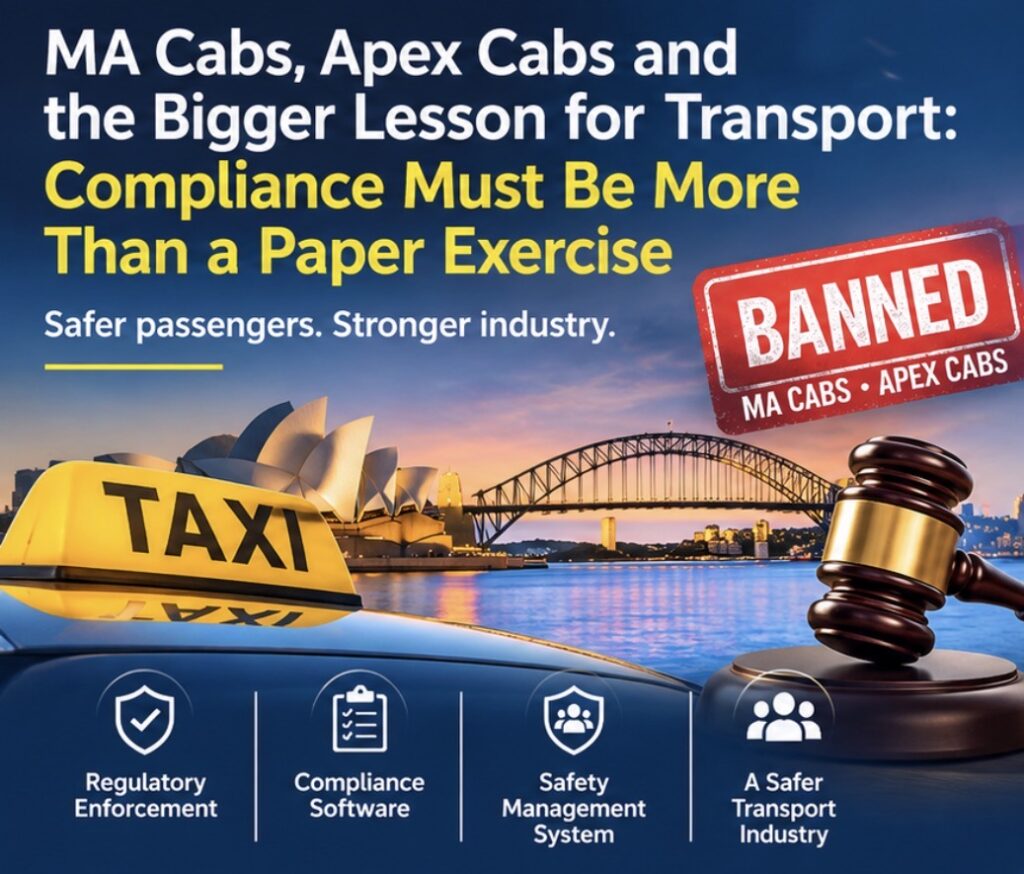
The recent NSW action against MA Cabs, following the earlier Apex Cabs case, highlights why transport operators must take compliance, passenger safety and accountability seriously. Effective regulation must not only remove non-compliant operators from the road but also ensure they cannot simply reappear under another name. For transport businesses, robust compliance SaaS and a documented Safety Management System (SMS) are essential tools for managing risks, monitoring obligations and maintaining industry standards. Through the Ridyne banner, we support a proactive approach to compliance that helps operators build safer, more accountable and professional transport services.
- Regulatory enforcement matters: NSW’s action against taxi operators demonstrates the importance of holding service providers accountable for serious compliance concerns.
- A ban must mean a ban: Regulators need the ability to investigate and address attempts to continue operating through another brand or business structure.
- Compliance must be continuous: Operators need effective systems to manage obligations, drivers, vehicles, incidents, complaints and corrective actions.
- Safety requires a documented framework: A robust Safety Management System (SMS) should define responsibilities, identify risks, establish controls and support continual improvement.
- Ridyne brings the two together: Compliance SaaS and a documented SMS, supplied under the Ridyne banner, can help transport organisations build a more structured, accountable approach to operational safety.
A welcome move towards safer passenger transport
The NSW Government’s action against taxi operators facing serious compliance concerns is an encouraging development for passengers and legitimate businesses across the transport industry.
Passengers should be able to expect that their taxi or booked transport service is operated by a responsible provider, with appropriate systems in place to support safe vehicles, compliant drivers, transparent fares and effective complaint handling.
Responsible operators invest time and resources into meeting their obligations. They should not have to compete against businesses that disregard the rules designed to protect passengers and maintain industry standards.
Where serious breaches are established and operating authorisations are cancelled, that action can help protect the public and reinforce the principle that compliance is a fundamental requirement of operating a transport business.
However, effective regulation involves more than issuing a cancellation notice. It also requires appropriate follow-up to ensure that a banned operator cannot simply continue substantially the same operation under another name.
MA Cabs: what the 2GB Sydney interview revealed
After hearing the 2GB Sydney interview with Ben Fordham and Nick Abrahim, CEO of the NSW Taxi Council, the discussion highlights why regulators and transport operators must look beyond individual incidents and examine the systems and management practices behind a service provider.
During the interview, Abrahim confirmed that MA Cabs had its authorisation to operate as a taxi service provider cancelled by the NSW Point to Point Transport Commissioner.
He discussed concerns relating to taxi meter operating systems, company policies and procedures, and the handling and volume of complaints.
His comments made an important distinction: the issue being raised was not simply whether individual drivers had behaved improperly, but whether the organisation managing the fleet had adequate systems, policies and practices in place.
That distinction matters across every part of the transport industry.
Drivers are responsible for their own conduct, but operators also have responsibilities for the systems through which their services are delivered, the standards they set, and the way they monitor and respond to problems.
The interview also raised a significant concern about whether vehicles associated with MA Cabs had moved to another brand on the day they were supposed to come off the road.
Nick Abrahim compared this with the earlier Apex Cabs case, saying vehicles had reappeared under a different brand after that operator was banned.
These statements were made during the broadcast and should be understood as the Taxi Council CEO Nick Abrahim reported concerns, rather than treated as a final regulatory finding that a replacement business had breached the law.
Listen to the 2GB Sydney interview here
The wider question for regulators is clear: what mechanisms are available to identify and investigate attempts to circumvent an operating ban?
A business name can change. A fleet’s branding can change. But where evidence suggests that a prohibited operation is continuing in substance, regulators need effective tools to investigate the circumstances and apply the law.
This protects passengers, supports compliant operators and reinforces confidence in the regulatory framework.
Why compliance needs to be built into everyday operations
The MA Cabs discussion provides a timely reminder that compliance should not be treated as an administrative exercise performed only when a regulator asks questions.
Transport businesses operate in a changing environment of legislation, licensing obligations, vehicle requirements, driver responsibilities, passenger expectations and operational risks.
Managing these obligations through disconnected documents, emails and spreadsheets can make it difficult to maintain a clear picture of what has been completed, what remains outstanding and who is accountable.
A structured compliance SaaS platform can help bring these processes together.
Depending on the operator’s requirements and the platform’s configured capabilities, a well-designed system can support:
- Obligation management: identifying applicable requirements, assigning responsibilities and recording completion.
- Driver and vehicle compliance: maintaining records, tracking required checks and monitoring outstanding actions.
- Incident and hazard reporting: capturing issues, assessing risks and documenting responses.
- Complaint management: recording concerns, investigating their causes and tracking resolutions.
- Corrective actions: assigning remedial work, setting deadlines and retaining evidence of completion.
- Audit readiness: maintaining accessible records that help demonstrate how the organisation manages its obligations.
- Management oversight: reviewing outstanding issues, recurring trends and opportunities to improve performance.
The value is not simply having information stored digitally. It is having a consistent process for turning requirements into actions, and actions into evidence.
Software cannot replace competent management, appropriate training or regulatory oversight. It can, however, help organisations establish more reliable processes and maintain better visibility of their responsibilities.
A Safety Management System is the foundation
Compliance software is most effective when it operates alongside a robust, documented Safety Management System.
An SMS provides the framework through which an organisation identifies hazards, assesses risks, determines controls, allocates responsibilities, reports incidents and continually improves its safety performance.
A meaningful SMS should address the organisation’s actual operations rather than exist as a generic document prepared simply to satisfy a checklist.
Depending on the nature and scale of the business, it should establish clear processes for:
1. Safety responsibilities
Define who is responsible for safety decisions, operational oversight, reporting and corrective action.
2. Risk identification and assessment
Identify foreseeable hazards, assess their potential consequences and establish proportionate controls.
3. Operational procedures
Document the processes employees and contractors are expected to follow, including relevant driver, vehicle and passenger safety requirements.
4. Incident and complaint management
Provide clear procedures for reporting, investigating, recording and responding to incidents and complaints.
5. Corrective and preventive action
Ensure identified problems lead to appropriate action, with responsibilities, timeframes and evidence of completion.
6. Review and continual improvement
Monitor whether controls are working, identify recurring problems and update procedures when circumstances or requirements change.
A documented SMS establishes what should happen. The compliance platform can help an organisation manage the tasks, evidence and follow-up needed to put that framework into practice.
The two should work together as part of the organisation’s everyday management system.
Ridyne: bringing compliance and safety management together
Under the Ridyne banner, compliance SaaS and a robust, documented Safety Management System are supplied to help transport operators take a more structured approach to compliance and operational safety.
The aim is to help businesses establish clear responsibilities, manage important records, monitor outstanding requirements and maintain documented processes that support their operations.
For taxi operators, charter providers, hire vehicle businesses, passenger transport companies and other On Demand service providers, this approach can help move compliance away from reactive paperwork and towards a more proactive management discipline.
Every operator has different risks and obligations. The appropriate system must therefore reflect the applicable legislation, the type of transport service provided and the organisation’s operational circumstances.
The objective is straightforward: make compliance more manageable, make safety responsibilities clearer and help operators maintain the records and processes needed to demonstrate how they manage risk.
Compliance technology supports the process. A well-designed SMS provides the framework. Management commitment makes both effective.
Preventing problems rather than responding after the event
One of the most important lessons from regulatory action is that a business should not wait until a serious incident or investigation exposes weaknesses in its systems.
A proactive operator asks questions before problems occur:
- Are our responsibilities clearly documented?
- Can we identify outstanding compliance requirements?
- Are incidents and complaints investigated consistently?
- Do we know whether corrective actions have been completed?
- Can we demonstrate that our documented procedures are being followed?
- Do we review our risks and improve our processes as our business changes?
These questions are relevant to established operators and new entrants alike.
They also reinforce the importance of maintaining a professional separation between a business’s branding and its underlying responsibilities. Changing a name or structure does not remove the need to meet the legal obligations applicable to the operation.
Where a regulator has cancelled an authorisation, any suspected attempt to evade that cancellation should be assessed by the appropriate authority on the evidence and under the law.
Supporting higher standards in Western Australia and beyond
While the MA Cabs and Apex Cabs cases concern NSW, the underlying principles are relevant to passenger transport operators across Australia.
Safe and reliable transport depends on responsible operators, competent drivers, effective regulatory oversight and systems that support accountability.
Ridyne and My Getaway Driver support all organisations working to maintain and improve standards across the transport and On Demand sector, including DTMI in Western Australia. We support a professional industry in which safety is taken seriously, compliance is managed proactively, and operators are equipped with practical systems and documented processes to meet their responsibilities.
Our position is simple: the industry is stronger when legitimate operators are supported, passengers are protected, and organisations are held accountable for meeting the standards that apply to them.
The NSW action is a timely reminder that compliance is not a box to tick. It is an ongoing responsibility.
A safer transport industry starts with accountable operators, robust compliance systems and a Safety Management System that is actively used—not simply filed away.